THE FOUNDATION OF THE MUSÉE NATIONAL DES BEAUX-ARTS DU QUÉBEC UNVEILS THE NAME OF THE FUTURE PAVILION AT THE MUSEUM CAMPUS : ESPACE RIOPELLE - PAVILLON MICHAEL AUDAIN
Canada NewsWire
QUEBEC CITY, Feb. 17, 2026
Historical donation to the Foundation of Musée national des beaux-arts du Québec
QUEBEC CITY, Feb. 17, 2026 /CNW/ - The MNBAQ Foundation recognizes the exceptional philanthropic commitment of businessman Michael Audain to the Musée national des beaux-arts du Québec (MNBAQ). Totaling $91.3 million, including $76.9 million in donations of artworks, his exceptional contribution supports the realization of one of the Museum's flagship projects at a pivotal moment in its history. To honour this historic contribution, the future MNBAQ pavilion will be named Espace Riopelle – Pavillon Michael Audain.
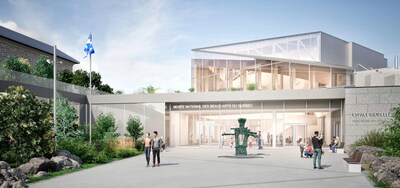
The announcement is part of a renewed philanthropic approach, developed in collaboration with the Museum, aimed at firmly embedding private support within its evolution and outreach. Through his decisive commitment, Mr. Audain sends a strong signal and encourages other major philanthropists to contribute to the future of the MNBAQ, for the benefit of artistic heritage and its transmission. The momentum generated by the Riopelle centenary celebrations, led by the Riopelle Foundation over the past four years, strengthens this movement and extends the major philanthropic commitments that have shaped the Museum's recent history, notably that of Pierre Lassonde, whose eponymous pavilion opened in 2016.
"Congratulations to Mr. Michael Audain on this highly deserved honour, which highlights his exceptional contribution to the development and influence of the Museum. Philanthropy is a powerful lever for building connections between the cultural community, the public, and the business sector, and Mr. Audain's commitment is a compelling demonstration of this. I hope his generosity will inspire many business leaders to follow his example." — Mr. Mathieu Lacombe, Minister of Culture and Communications, and Minister responsible for the Outaouais region
Today's announcement is intended to be the first milestone in a series of initiatives that will punctuate the year 2026, culminating in October 2026 with the opening of the Espace Riopelle and the holding of an international symposium that will conclude the celebrations of Riopelle's centenary, taking a look at this exceptional case that will redefine the strategies for commemorating artists who have shaped our art history.
"As the birthplace of Jean Paul Riopelle and the Automatistes, whose avant-gardism was unparalleled in Canadian art at the time, Quebec struck me as the ideal place for this legacy. I have a deep admiration for Quebec, its culture, and its history. Like its official language, culture is elevated to the status of a pillar of identity. In the name of collective pride, Quebec does not hesitate to promote its artists. Its cultural policies stand out sharply from the dynamics observed across Canada. In Quebec, the government's intervention, compared to that of the federal and municipal levels, is far more decisive than what is seen elsewhere in the country. This distinction deserves to be fully recognized. I wish to express my sincere gratitude to the Government of Quebec for this exceptional partnership in creating a home for Jean Paul Riopelle, Canada's most internationally famous artist, and his colleagues." – Michael Audain, chairman, Audain Foundation
Michael Audain: A Discerning and Enlightened Collector
Far beyond a desire to invest in works of art with significant market value, Michael Audain practises engaged and socially beneficial collecting. Driven by a desire to pay homage to those he considers cultural heroes, he has been particularly interested in artists who have brought about social transformation. His acquisitions notably include an impressive body of work by Mexican modernist artists, such as Diego Rivera, who made art a revolutionary language, as well as major figures of Automatism in Quebec, including Paul Émile Borduas, Marcelle Ferron, and Jean Paul Riopelle. His fascination with Riopelle emerged in the early 1950s, decades before he could afford to collect his works and assemble the most important private collection of Riopelle's art. It was at this time that he developed a keen interest in the history of Quebec, its artists, and the role of the Automatistes in the advent of the Quiet Revolution. His work also highlights Canadian cultural diversity. The permanent collection of the Audain Art Museum in Whistler, comprising over 300 works spanning the 18th century to the present day, reflects this vision. It includes one of the most important collections of masks from the First Nations of the Northwest Coast, major works by Emily Carr representing all periods of her career, as well as modernist and contemporary artists from British Columbia, many of whom are First Nations.
Michael Audain: A Visionary Philanthropist
A leading figure in visual arts patronage in Canada, Audain embodies transformative philanthropy. Beyond donations of artworks and financial contributions, he prioritizes long-term partnerships with institutions and artists. His commitment supports contemporary creation, notably through the Audain Prize for Visual Arts, launched in 2004, which annually awards $100,000 to a British Columbian artist, recognizing their lifetime achievement and which now ranks among the highest artistic distinctions in the country.
A Vancouver-based businessman, Audain is chairman of Polygon Homes, one of British Columbia's leading real estate home builders. With a long history of activism and social engagement, he and his wife, Yoshiko Karasawa, founded the Audain Foundation in 1997, which has profoundly shaped the Canadian cultural landscape. Since its inception, the Audain Foundation has granted over $200 million, excluding donations of artworks, in support of the visual arts.
Driven by a desire to nurture the memory and cultural awareness of communities, his philanthropy transforms the relationship between a society and its artists. By donating major works to public institutions like the Musée national des beaux-arts du Québec (MNBAQ), he provides universal access to otherwise inaccessible masterpieces. The acquisition of the Audain Collection of works by Jean Paul Riopelle solidifies the MNBAQ's status as a global leader in Quebec art.
"Michael Audain's gesture sends a powerful message to cultural philanthropy in Quebec. By choosing to make artistic heritage a truly shared asset, he demonstrates that the commitment of individuals and businesses can not only accelerate structuring projects but also become their decisive driving force. His leadership strengthens our institutions and expands their reach far beyond our borders. Above all, it reminds us that culture is a collective responsibility and that the convergence of private commitment and public action allows us to build lasting legacies. It is this collaborative vision that enables us today to imagine and implement ambitious projects so that art plays an ever-greater role in our lives and in our society." – Fabrice Alcayde, Executive director, MNBAQ Foundation
Espace Riopelle and the Michael Audain Pavilion are not merely the setting for an exceptional legacy; they are also contributing to the transformation of the Museum, enhancing the visitor experience and the international appeal of the national collection. A committed partner of the MNBAQ since 2016, Michael Audain has been instrumental in supporting Espace Riopelle project, notably with a $10 million donation in 2021, followed in 2022 by the donation of eight works by Paul Émile Borduas valued at approximately $9 million. In 2025, Audain also granted the MNBAQ a $2 million endowment to establish the Audain Museum Chair for the Automatistes. His commitment reflects a long-term vision aimed at ensuring the enduring legacy and influence of the artists who shaped our cultural modernity.
"A museum supported by its community, its members, its donors, and its patrons is a healthy museum. It's a sign of relevant work deeply rooted in its community. The shift we are making, closer to the community and in constant dialogue, is in line with the practices of today's leading museums. Patronage is a powerful lever when it aligns with the museum's mission and is based on a shared vision and values. It is within this coherence, supported by clear governance, that patronage truly becomes a win-win situation for everyone and contributes to the museum's sustainability and ambition." – Jean-Luc Murray, Executive Director of the Museum
The naming strategy for the pavilions of the MNBAQ museum complex is rooted in this principle of sustainability. It serves as a structuring lever for the Museum's long-term viability, both financially and in terms of its role as custodian of the national collections, imbuing its spaces with the memory of those who contribute directly to enriching our collective heritage.
In the case of the Espace Riopelle – Pavillon Michael Audain, this approach translates into an unprecedented contribution to the national collection through the donation of artworks, support for research via the Audain Chair, and the strengthening of Quebec art both nationally and internationally. This model of collaborative philanthropy acts as a powerful incentive, reminding us that the institution's vitality rests on a carefully balanced relationship between public investment and private commitment.
Sustainability, Impact, and the Philanthropy of Tomorrow
Since the publication of the Bourgie Report in 2013, there has been a consensus that private philanthropy needs to be further stimulated in Quebec to support the artistic vitality and financial independence of cultural organizations. The report notably recommended strengthening the Mécénat Placement Culture program, which matches private donations with public funds to ensure the long-term financial sustainability of cultural organizations.
Since then, numerous reports, studies, and assessments have been produced regarding the landscape of cultural philanthropy in Quebec. Whether it's the review of cultural policies supporting philanthropy in Quebec conducted by Culture Montréal and HEC Montréal (2023), the Impact 0.4 study on the evolution of philanthropy in Quebec's arts and culture sector (2024), or the Cultivating Engagement: For Philanthropy Serving Culture study (2025), similar findings consistently emerge: in most areas of philanthropic intervention, Quebecers give less than their neighbours, culture is far from being a top priority for philanthropists, and it represents only a very small percentage of individual donations.
Having established this, what are the possible solutions? It seems reasonable to consider that the philanthropy model advocated by Michael Audain, focused on supporting the sustainability of institutions through infrastructure contributions that provide Quebec with new facilities and endowment funds, could inform this reflection. Since giving is the culmination of a relationship and interaction between the individual and the organization, it is conceivable that this model could inspire the development of a cultural philanthropy policy that facilitates encounters between individuals and organizations, thereby encouraging the development of a philanthropic culture where education about giving and the desire to give are fostered through cultural education and the transmission of this appreciation for culture.
ADDITIONAL LINK
Full press kit:
Access the link

SOURCE Fondation du Musée national des beaux-arts du Québec

